Sound familiar?Toronto
- The call
- You heard a sharp bang from the garage, and now the opener hums for a second and gives up. The door lifts a few centimetres at most, then settles back down as if something very heavy is holding it in place.
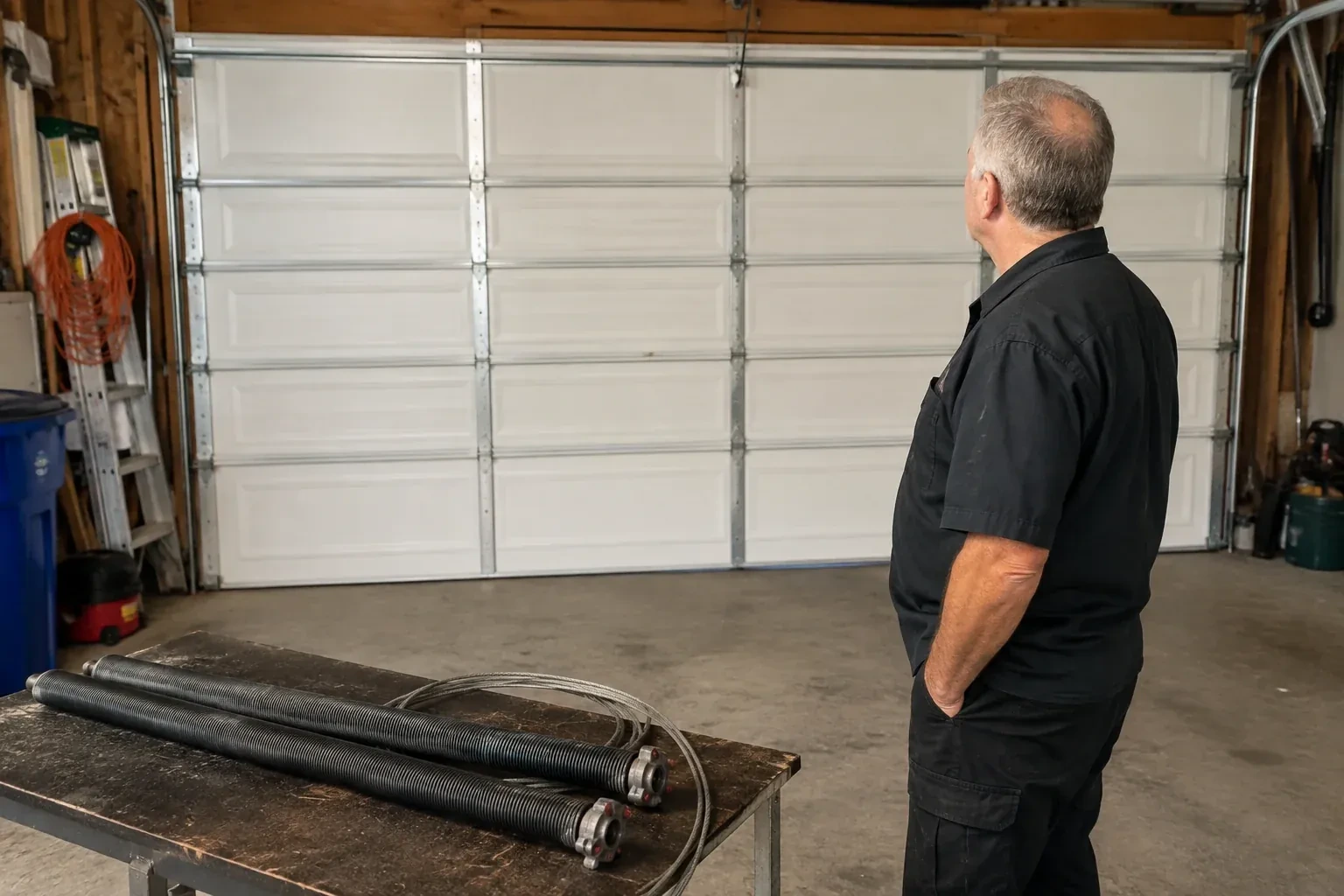
On a door with two springs, replacement usually starts with a conversation about scope. Both springs have completed the same number of cycles, so when one breaks the other is typically close behind, and replacing the pair together gives the door two matched springs sharing the load evenly. The technician explains what the installed system is, how each spring is loaded and what the door's weight calls for, then fits and winds the springs as a set. The result is a balanced door with a fresh cycle life on both sides rather than a repair that may be repeated soon.
Sound familiar?Toronto
Torsion Spring Replacement · Toronto
Scene 1
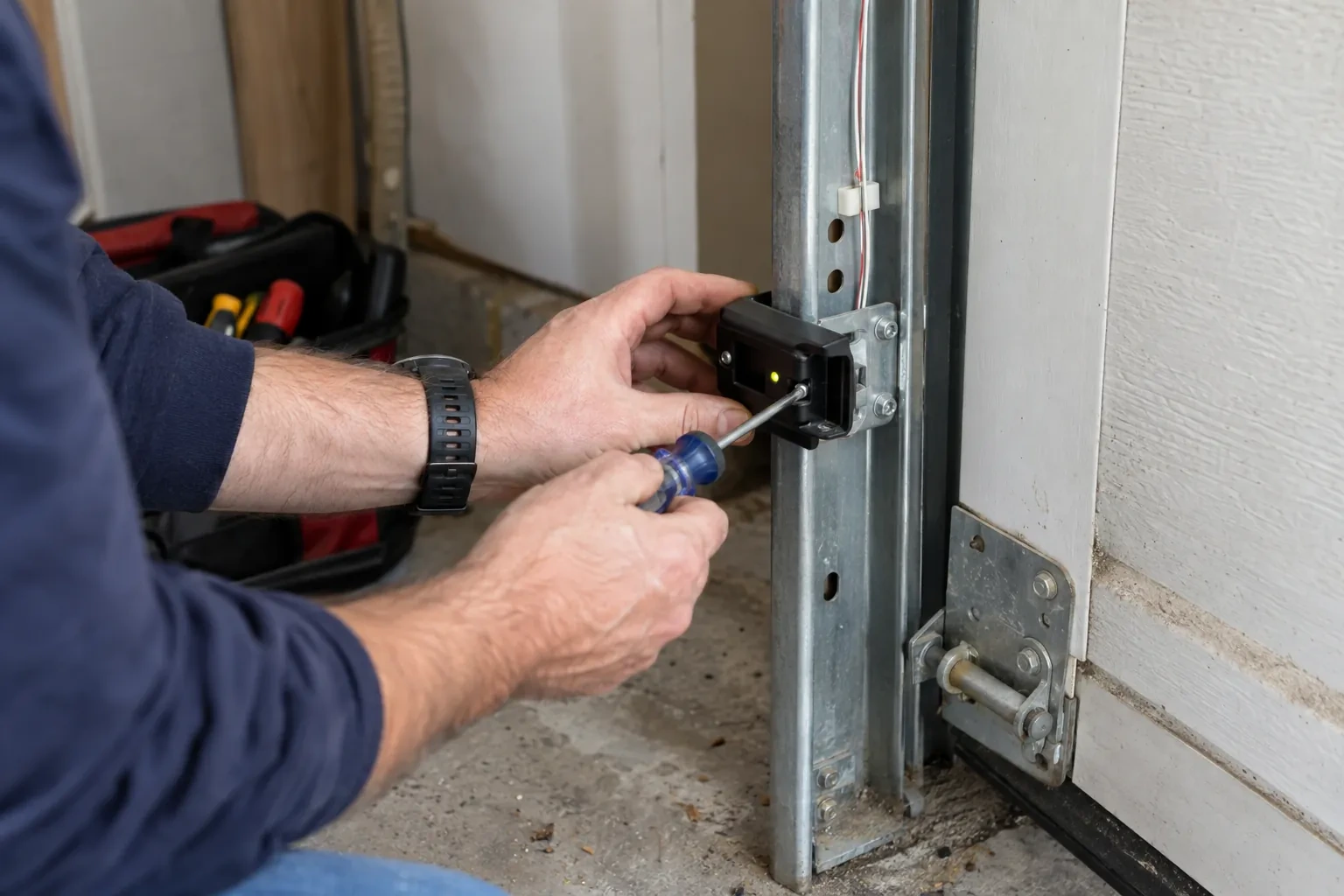
The spring is one part of a chain, so the check follows that chain from the shaft outward. The centre bearing and the end bearings are turned by hand to feel for roughness or wobble. Cable drums are inspected for cracked flanges and worn grooves, and lift cables are examined along their length and at the bottom brackets, where fraying and rust usually start. Bottom brackets and their fasteners are looked at for corrosion, and the shaft is checked for straightness. Findings here decide whether the visit is a spring swap alone or a spring plus a few tired companions.
Scene 2
Winding is where a spring takes on its working tension, and it is done with two solid steel bars sized to the holes in the winding cone. The technician stands to the side of the cone, inserts one bar, turns a quarter turn, inserts the second bar, and transfers the load from bar to bar so the spring is never held by less than a full bar. The number of quarter turns is counted against the door height and drum type. When the count is reached, the spring is stretched slightly toward the drum and the set screws are tightened to the shaft while the last bar still carries the load.
Scene 3
A little care keeps the new spring running smoothly for its full life. Once or twice a year, spray the coils with a garage-door lubricant so the steel moves without rubbing, and do the same for the hinges, roller bearings and the end bearings at each side of the shaft. Autumn is a good time, since cold thickens grease and stiffens hardware. Leave the track dry, because lubricant there collects grit. Over the years, glance at the spring for gaps or rust streaks, and if the door starts to feel heavier by hand, book a balance check before a spring reaches its limit.
What shapes the quoteFlemingdon Park Garage Door Repair Co.
FeesSame any hour
Not necessarily, and that is fine. The paint colour on the winding cone or coil is a code that identifies wire size and wind direction, and different suppliers use their own schemes, so a matched replacement can carry a different colour than the spring it replaces. What matters is that the wire size, diameter, length and wind direction suit the door's weight and height, which is confirmed by the balance test.
A spring that is intact but has relaxed slightly can be given a little more tension, within limits, to restore balance; this is a normal adjustment on a door that has settled. A spring with a broken coil is replaced as a unit, since the wire has reached the end of its life. The technician checks the condition of the steel and recommends whichever restores a balanced, safe door.
Cold makes steel slightly less forgiving and thickens the grease on the coils, so a spring that has already used most of its cycle life is more likely to let go on a frosty morning when the door is first opened. The cold is the final straw rather than the cause; the underlying reason is fatigue from years of cycles, sometimes helped along by rust and dry coils.
TorontoOntario
Torsion Spring Replacement · Flemingdon Park, Leaside, Parkview Hill, Thorncliffe, Woodbine Heights
Every square is one home in a hundred.
On-site assessment
The door drops the last stretch to the floor rather than settling, and when you stop it halfway by hand it slides down instead of staying put.
(289) 806-2118, open 24/7.
On-site assessment preferred · (289) 806-2118, open 24/7